Showing posts with label World War II. Show all posts

Tuesday, January 23, 2024

Escape from Amsterdam

Remembering Grandpa Harry: On November 1, 2005, the United Nations General Assembly designated January 27 - the anniversary of the 1945 liberation of Auschwitz - as International Holocaust Remembrance Day. 

International Holocaust Remembrance Day

To mark the day, Abq Jew offers a true story - a portion of the extensive foundation story of his mechutan's (his son's father-in-law) family. 

Abq Jew first heard the story a few years ago, when Cousin R. posted it on Facebook. Cousin R. learned the story from her father - and from Grandpa Harry's written testimony.

Pegasus Devotacus

So. Who was Grandpa Harry? That's a story in itself! He was born in Berlin in 1907, studied law and classical philology, and earned his doctorate in 1929 at the University of Leipzig. 

He then studied economics at the London School of Economics, to prepare himself for a job in the tobacco industry - his father [Great Grand Papa David] was a partner in the Reemtsma cigarette factories GmbH. 

Reemtsma

In 1935, following warnings from the Reemtsma family, Grandpa Harry emigrated to the Netherlands and worked for the Zionist movement in Amsterdam. 

In 1940, four days after the German attack on the Netherlands in World War II, he and his family managed to escape to England. 
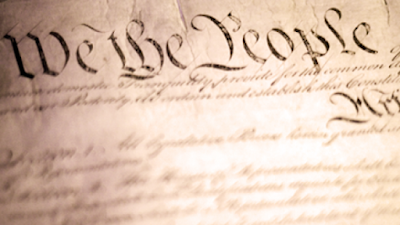
We The People

Cousin R. strongly supports America's long tradition of birthright citizenship, which was then being questioned. 

As for Abq Jew - he is still fixated (see April 2023's Hiding During the Holocaust) on the travails of Dutch Jews during World War II. 

It's all connected.
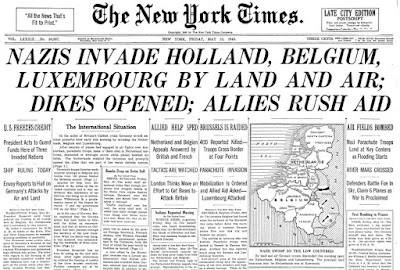
NY Times Invasion

1.

Cousin R. begins the story:

My paternal grandparents [Grandpa Harry and Grandma Claire] were born in Germany. When the Nazis came to power they stripped all Jews, my grandparents included, of their German citizenship, effectively rendering them stateless—citizens of no where.  
My father’s family was very, very fortunate in that they had international connections because of my great grandfather’s business ties. My grandparents first went to England, where my Aunt C. was born. At that time, England had birthright citizenship and C., by virtue of her birth, was a British subject.
The family then went to Holland, where my father and his younger sister were born. Holland didn’t have birthright citizenship. Children were whatever the citizenship of their parents were. But my grandparents had lost their German citizenship so my father and his little sister were stateless too.

In 1940, when C.was 5 and my father was 3, the Nazis invaded Holland.

2.

An historical refresher: Before May 10, 1940, the fundamental principle and profound hope of Dutch foreign policy was neutrality - as it had been for a century. 

The Netherlands had avoided getting involved in World War I, and - in order to preserve their country's neutrality - the Dutch government had been careful not to take an official stand on the situation in Nazi Germany.

Nevertheless. In the early morning of May 10, 1940, Dutch observers saw bombers from the German Luftwaffe flying in the direction of the North Sea. They assumed that they were on their way to England. But once over sea, the planes made 180-degree turns and flew back to attack the Netherlands. 

The Netherlands was at war.
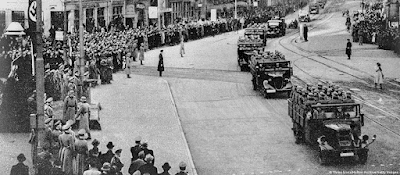
Germans Occupy Netherlands

3.

Here is how Grandpa Harry begins his story:

In the early hours of May 10th, 1940 -  it is still dark - I am aroused by the thunder of gunfire and the booming of exploding bombs. It is shortly after 3 o'clock. 

I can guess what has happened: rushing down and switching on the radio, I can hear the excited voice of the announcer giving the awful news of the German invasion.  

It has come at last, what we had feared but refused to believe. I rush into my wife's room. She too has been wakened by the guns. "It has come!" She understands me. While the sun gradually climbs higher in a brilliant blue sky, we hurriedly don our clothes. 

The children are still asleep. Am I dreaming all this? No  -  the loudspeaker keeps booming out the horrible truth. 

Claire and I hold a council of war. There is terror in her eyes, but she is trying hard not to show it. Months ago we made our preparations: paltry enough, it is true, but all we could do. 

A large handbag contains our jewellery, and, what is much more important, our papers. 

What is man, and more especially a Jew, without papers? There they are, neatly stacked, certificates of birth and marriage, originals and photocopies and among them C.'s British passport. 
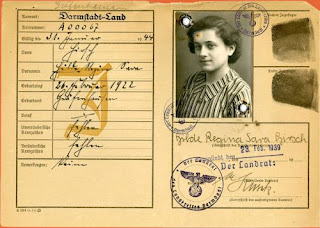
ID Card

4.

Cousin R. continues:

As [the German army] approached Amsterdam, where my father’s family lived, my grandparents frantically tried to flee. Forced to stay inside, because the Dutch considered them German, they struggled to at least save their children’s lives.
The British sent a ship to evacuate British subjects. Because C. had a British passport, in a desperate attempt to save her children, my grandmother sent C. and my father with a neighbor to the British embassy.  
She sent a 5 year old and a 3 year old to go with strangers to save their lives. Think about that.
The neighbor returned with my father. He wasn’t British so they wouldn’t evacuate him.  
“No one wants a stateless Jewish boy,” my grandfather would later write. No one protects you if you are stateless.

5.

Cousin R. concludes:

My grandparents and their youngest two children were eventually able to secure passage on the last ship of refugees leaving Holland.  

SS Bodegraven

The last ship of refugees to leave Holland before ports were closed - a few hours before the Netherlands surrendered - was the S.S. Bodegraven. 

The ship left IJmuiden harbor on May 14, 1940, carrying about 250 refugees - including 74 Kindertransport children, rescued from an Amsterdam orphanage. After five days under attack from German aircraft, the ship finally reached Liverpool. 

This was the last Kindertransport from the European continent.
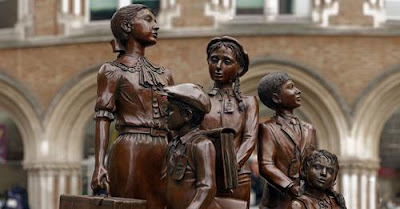
Kindertransport

Grandpa Harry's story does not end there - and Abq Jew has omitted many personal details and world events that make his story even more compelling.


Four Winters

As are all Holocaust stories.

Remembrance

Wednesday, April 19, 2023

Mordechai: After 80 Years

The Beginning of Modern Jewish History: Ten years ago (see From Mordechai to Mordechai), Abq Jew published this blog post in honor and remembrance of the Warsaw Ghetto Uprising of April 1943. Eighty years ago today.

Warsaw Ghetto 80

Seventy years ago, modern Jewish history began when the Jews of the Warsaw Ghetto rose up to combat their tormentors.


 Yes, Abq Jew is aware that this statement oversimplifies and overlooks. The website of the United States Holocaust Memorial Museum tells us:
Between 1941 and 1943, underground resistance movements developed in approximately 100 ghettos in Nazi-occupied eastern Europe (about one-fourth of all ghettos), especially in Poland, Lithuania, Belorussia, and the Ukraine. Their main goals were to organize uprisings, break out of the ghettos, and join partisan units in the fight against the Germans.
Jews fought back, both spiritually and physically. Jews fought back, in camps and in ghettos. Nevertheless:
The Warsaw ghetto uprising in the spring of 1943 was the largest single revolt by Jews. Hundreds of Jews fought the Germans and their auxiliaries in the streets of the ghetto. Thousands of Jews refused to obey German orders to report to an assembly point for deportation. In the end the Nazis burned the ghetto to the ground to force the Jews out. Although they knew defeat was certain, Jews in the ghetto fought desperately and valiantly. 
 rememberrememberrememberrememberrememberrememberrememberrememberremember

Since the 12 century, there has been a saying: 

From Moses to Moses, there was none like Moses.

Which is to say: from Moshe Rabbenu until Maimonides (Rabbi Moshe ben Maimon), there was none like Moshe.

Abq Jew would like to propose a new saying:

From Mordechai to Mordechai,
there was none like Mordechai.

Which is to say: from Mordechai the Jew in Shushan the Capital until Mordechai Anielewicz the Jew in Warsaw the Capital, there was none like Mordechai.

Mordechai Anielewicz (1919 – 8 May 1943) was the leader of Żydowska Organizacja Bojowa (Jewish Combat Organization), also known as ŻOB, during the Warsaw Ghetto Uprising. 

Wikipedia further states:
Anielewicz was instrumental in the first act of the Warsaw Ghetto Uprising, preventing the majority of a second wave of Jews from being deported to extermination camps. This initial incident of armed resistance was a prelude to the Warsaw Ghetto Uprising that commenced on 19 April.

Though there were no surviving eyewitnesses, it is assumed that he took his own life on 8 May 1943, along with his girlfriend and many of his staff, in a mass suicide at the surrounded ŻOB command post at 18 Miła Street. His body was never found and it is generally believed that it was carried off to nearby crematoria along with those of all the other Jewish dead; nevertheless, the inscription on the obelisk at the site of the Miła 18 bunker states that he is buried there.
 The Midrash tells us:

Mordechai, in his generation, was equal to Moshe in his.

rememberrememberrememberrememberrememberrememberrememberrememberremember

Just a few kilometers south of Ashkelon (Abq Jew's former home in the Land of Israel), just north of the Gaza Strip, stands Kibbutz Yad Mordechai.

Monument to Mordechai Anielewicz at Kibbutz Yad Mordechai, by Nathan Rapoport

Yad Mordechai - named, of course, in honor of Mordechai Anielewicz - is often skipped over on Holy Land tours. In Jerusalem, tourists and worshipers visit Yad VaShem. In the north, they often visit Kibbutz Lochmei HaGetaot (Ghetto Fighters).

But Yad Mordechai holds a special place in Jewish and Israeli history - because of the bravery shown there during a few days in May 1948. Wikipedia tells us:
The Battle of Yad Mordechai was fought between Egypt and Israel in the 1948 Arab-Israeli War, at the Israeli kibbutz of Yad Mordechai. The Egyptians attacked the communal village several times throughout May 19 and May 20, but failed to capture it.
A final attack was launched on May 23, in which the Egyptians succeeded in capturing part of Yad Mordechai, following which the Israeli defenders withdrew. Yad Mordechai finally fell to the Egyptians on May 24 after hours of bombardment of the vacated kibbutz.

The kibbutz residents, aided by twenty Haganah fighters, imposed a five-day delay on the Egyptians. This gave Israeli forces time to prepare for the Egyptians' northward advance, and they succeeded in halting the Egyptian advance at Ad Halom less than a week later.
 rememberrememberrememberrememberrememberrememberrememberrememberremember

In five years, the Jewish People moved from the Warsaw Ghetto to Yad Mordechai; from the doomed Uprising to the victorious War of Independence. In just five years.

The Forward reports (via Haaretz):
Polish President Bronisław Komorowski [last] week announced his sponsorship of events commemorating the 70th anniversary of the Warsaw Ghetto Uprising and the Nazis’ destruction of Warsaw’s Great Synagogue.
מי ימלל גבורות ישׂראל

Tuesday, March 21, 2023

Remembering Varian Fry

His Bravery Unsung: Varian Fry acted - bravely, fiercely, fearlessly - to save Jews - many Jews; many rich and/or famous Jews - during the Holocaust. 

But before reading Dara Horn's 2021 collection of essays, People Love Dead Jews: Reports from a Haunted Present, a "startling exploration of how Jewish history is exploited to flatter the living," (see February's Thinking About Anne Frank), Abq Jew had only vaguely heard of him.

Varian Fry

Do you know who Varian Fry was? More importantly, do you know what Varian Fry did? Wikipedia tells us

Varian Mackey Fry (October 15, 1907 – September 13, 1967) was an American journalist. Fry ran a rescue network in Vichy France that helped approximately 2,000 to 4,000 anti-Nazi and Jewish refugees to escape Nazi Germany and the Holocaust. 

He was the first of five Americans to be recognized as "Righteous Among the Nations", an honorific given by the State of Israel to non-Jews who risked their lives to save Jews during the Holocaust.

People Love Dara Horn

But that is hardly the whole story of Varian Fry. Dara Horn comes much closer with her essay "On Rescuing Jews and Others," originally published in 2012 as "The Rescuer." Goodreads tells us

In 1941, a young Harvard-educated classicist named Varian Fry arrived in occupied France on a daring mission to rescue more than 2,000 of Europe's leading writers, artists, and intellectuals from the Nazis. 

Hounded by the Gestapo, he smuggled Marchel Duchamp, Marc Chagall, Hannah Arendt and dozens of other 20th century cultural luminaries out of France and brought them to America. 

So why did even the people Fry saved want to forget him? 

In this fascinating psychological profile, acclaimed novelist Dara Horn, chosen by Granta magazine as one of the 25 best young novelists in America, follows the peculiar life and legacy of an American Oskar Schindler. 

In the process, she reveals the secrets of a man who risked his life when others were silent — and the unforeseen consequences, personal and cultural, of his bravery.

In his review of People Love Dead Jews, author Tom Reiss writes

Dara Horn has an uncommon mastery of the literary essay, and she applies it here with a relentless, even furious purpose. Horn makes well-worn debates — on Anne Frank and Hannah Arendt, for instance — newly provocative and urgent. 

Her best essays are by turns tragic and comic, and her magnificent mini-biography of Varian Fry alone justifies paying the full hardcover price.

But wait - there's much more.

In 2017, Ginia Bellafante wrote in The New York Times

In June of 1935, two years after the German government falsely portrayed the burning of the Reichstag as a Communist plot to overthrow the state and just at the moment that it had banned all but “Aryans’’ from serving in the military and made homosexuality a crime, Varian Fry, a young Manhattan editor who was preparing to take over a magazine called The Living Age, traveled to Berlin.

About one month into his stay, he witnessed a night of gruesome rioting in which Jews were kicked, bloodied and spat on, leaving him to provide one of the earliest accounts of Nazi cruelties in the American news media. Relaying his observations to The Associated Press, Fry remarked that the police “nowhere’’ seemed “to make any effort whatever to save victims from this brutality.’’

Occasionally, he said, “they attempted to clear areas for motor traffic,’’ or to keep people from congregating in front of beloved cafes, but “that was all.’’ The crowds — made up of people young and old, well-bred-looking and common — chanting “‘The best Jew is a dead Jew,’” he continued, conducted themselves as if “in holiday mood.’’

The impression left was so searing
that journalism alone became insufficient. 

With that in mind, in August 1940, Fry, a Protestant and 32-year-old, went to Marseilles to begin a covert rescue operation that during his 13-month stay would result in the escape of more than 2,000 people, among them many artists and intellectuals, including Marc Chagall, Hannah Arendt, Max Ernst, Heinrich Mann, Marcel Duchamp, André Breton, Jacques Lipchitz and Alma Mahler, who crossed the Pyrenees carrying Gustav Mahler’s Symphony No. 10, her former husband’s final composition. 

And now Netflix tells the story. 

Transatlantic

Emily Burack writes in Town & Country magazine

Everything We Know About New Netflix Period Drama Transatlantic

The show will tell the story of American journalist Varian Fry who travels to Nazi-occupied France to help save artists and writers.

A new period drama is coming to Netflix this spring, and we can't wait. Transatlantic tells the true story of Varian Fry, a journalist who arrives in France in 1940 and quickly forms the Emergency Rescue Committee—dedicated to helping artists and writers flee the Nazis and immigrate to the United States.

Fry and American heiress Mary Jayne Gold, who helped lead the efforts, found themselves hiding out in a French villa. The two would help some of Europe's most prominent artists and thinkers flee, including Hannah Arendt, Max Ernst, Marcel Duchamp, and Marc Chagall. 

Fry would later become the first American to be named "Righteous Among the Nations" by Yad Vashem, Israel's Holocaust museum, for his efforts saving so many Jewish refugees.

Transatlantic is based on The Flight Portfolio, a novel by award-winning author Julie Orringer. Featuring an international cast, the 7-episode Netflix drama filmed on location in Marseille, France.

Transatlantic

Premieres April 7, 2023

Wednesday, July 10, 2019

The West Loch Incident

More LST-273 Exploits: This August, Abq Jew will observe what would be the 95th birthday of his father, Richard W Yellin, of blessed memory.


As Abq Jew wrote in December 2011 (see Boogie Woogie), Dad served in the Navy during World War II, mostly aboard LST 273.  

"LST" officially stands for "Landing Ship, Tank", whose job it was to drive right up onto the beach into direct enemy (in this case, Japanese) fire, and deposit its load of tanks, supplies, and troops.

LST 273 off Saipan, 16 June 1944

The Travels of LST 273

In preparation for Dad's 95th, Abq Jew has taken another look at some of the things Dad left behind. And: It turns out that Dad is in the above photo.

Abq Jew found a 2005 letter Dad wrote (in reply to another LSTer's letter) to the Scuttlebutt, the quarterly newsletter (and now the official website) of the United States LST Association.


In which Dad said:
I am a plankholder in LST 273, which also went down the Mississippi. That was in September 1943, after I finished Quartermaster classes at Great Lakes U. After shakedown and passing through the Panama Canal, we sailed to Long Beach, California, and then to Pearl Harbor. 
The 273 saw action in 
  • Kwajalein and Eniwetok [Jan-Feb 1944] in the Marshalls,
  • Saipan and Tinian [June-July 1944] in the Marianas, 
  • and then to Palau [Sep-Oct 1944]; 
  • it was in Pearl Harbor at the time [May 1944] of the West Loch incident. 

The West Loch Incident

More history: What, you may ask, was this West Loch incident? The disaster has been called "The Second Pearl Harbor" - but nobody seems to know about it.
The West Loch Disaster was a maritime accident during World War II at the Pearl Harbor U.S. Naval Base in Hawaii. The incident, which occurred just after 1500 hrs. on Sunday 21 May 1944, began following an explosion in a staging area for Landing Ships, Tank (LSTs) and other amphibious assault ships in West Loch. 
A fire quickly spread among the ships being prepared for Operation Forager, the invasion of the Japanese-held Mariana Islands. Over the next 24 hours, six LSTs sank, 163 naval personnel died and 396 were injured. 
A subsequent Naval Board of Inquiry never determined the exact cause of the disaster but concluded that the initial explosion was caused when a mortar round aboard LST-353 detonated during an unloading operation because it was either dropped or went off when gasoline vapors ignited. 
The incident – together with the Port Chicago disaster two months later – led to major changes in weapon handling practices within the United States Navy. 
The LST wreckage was quickly cleared in a salvage operation and dumped at sea 3 mi (2.6 nmi; 4.8 km) south of Hawaii.
Only the hull of the partially beached LST-480 was left in West Loch. A press blackout was enforced and naval personnel were ordered not to talk about the incident. 
The disaster was classified until 1960
and is therefore not well known.

[Dad never spoke about it.]

So, you (and Abq Jew) may ask:

Where Was LST 273?

As you would expect, Abq Jew did a lot more investigating around the Internet. In the Scuttlebutt, Mel Barger (LST-555) wrote about what he called the West Loch Tragedy:
West Loch was a busy area that day in 1944. Many of the ships were being loaded with ammunition, gasoline, and other cargo in preparation for the Marianas campaign. Marines and soldiers were also aboard the ships. 
And twenty-nine LSTs were berthed there to receive supplies from the West Loch Naval Ammunition Depot. 
  • LST-69 was berthed in a row identified as T-8, along with LSTs -205, -225, -274, -43, -179, -353, and -39. 
  • Next to them was T-9, which berthed LSTs -480, -140, -224, -340, -23, -462, and -222. 
  • The ships that would be lost in the disaster were LSTs -353, -179, -43, -480, and -69.  
Where were the other LSTs? And which LSTs were they? 

Google (at least the first several pages of results) did not provide the answer - but Dad did! While Abq Jew was putting away Dad's stuff until next time, he found this newspaper article that Dad had clipped and saved:


Which reveals, very clearly (Abq Jew magnified the photo), the exact location of LST-273 on that fateful day.

Here is the official lineup of 32 LSTs and three destroyers in the West Loch.
  • T-5: Five LSTs: LST 242, LST 126, LST 121, LST 45, LST 34
  • T-6: Five LSTs: LST 334, LST 20, LST 272, LST 169, LST 273
  • T-7: One LST: LST 29. Three destroyers: Waters, Stringham, Overton
  • T-8: Eight LSTs: LST 205, LST 225, LST 274, LST 69; LST 43, LST 179, LST 353, LST 39
  • T-9: Seven LSTs: LST 480; LST 240, LST 224, LST 340, LST 23, LST 461, LST 222
  • T-10: Six LSTs: LST 42, LST 275, LST 244, LST 166, LST 127, LST 128
This newspaper article indicates that five LSTs were destroyed (sunk) and one LST damaged in the disaster. LST 273 was some distance away and partially shielded from the explosions and fires.


Where Was Dad?

Abq Jew has Dad's complete (he believes) Navy personnel records from that time. So here is what Abq Jew thinks he has learned:
  • LST 273 and Dad were definitely at Eniwitok in February 1944.
  • LST-273 was definitely at Pearl Harbor's West Loch on May 21, 1944.
  • LST-273 and Dad were definitely at Saipan (Operation Forager) in June 1944. 
During the weeks before the West Loch disaster, the Navy was preparing the ships and rehearsing the men for the upcoming invasion of Saipan and the Marianas. Most likely, Dad and LST-273 took part in these exercises.

The day of the disaster was a Sunday. Many Navy personnel were on shore leave. Was Dad aboard LST-273? Abq Jew just doesn't know. Dad never said.

Which raises the next question:


What About Saipan?

WeAreTheMighty.com reports:
The Navy rallied after the incident, finding new ships and men to take over the mission. The LST fleet for the invasion of Saipan launched only one day late and made it to the Marianas quickly enough to invade on schedule on June 15, 1944. 
A media blackout kept most of America from hearing about the incident until it was declassified in 1960. Even today, it remains relatively unknown. 

You can read more about the West Loch Disaster here and here.
And here and here and here and here and here.

Keeping The Secret

About keeping the entire incident quiet: It was (of course) vitally important that the Japanese not learn about it. WarfareHistoryNetwork.com reports:
Historian Howard Shuman noted, “At least 250,000 people on ships and ashore at Pearl Harbor and tens of thousands more from Honolulu to Ewa saw the black smoke and fires and heard the blasts at West Loch. The disaster was not unknown.” 
Trying to downplay the disaster, [Admiral Chester] Nimitz (CINCPACFLT) issued the following statement: “An explosion and fire which occurred while ammunition was being unloaded from one group of landing craft moored together in Pearl Harbor on May 21, 1944, resulted in destruction of several small vessels, some loss of life, and a number of injuries. A court of inquiry has been convened….” 
Nimitz had put a beautiful little spin on a devastating accident. 
Fearing that word of the disaster would leak to the Japanese, a censor order was placed on the entire invasion force. As ordered by Admiral Nimitz, it was against regulations to talk about the disaster to others, including men from your own ship, or to write about it in letters home or elsewhere. 
William Wright, Jr., had been at paymaster school during the disaster but rejoined his ship just prior to the invasion. “I knew nothing about it until a long time later,” he recalled. “I didn’t even hear anybody talk about it among themselves. I guess they were threatened.” 
All of the official information and documents pertaining to the disaster, including the official court of inquiry transcripts and testimonies, were classified as TOP SECRET and stored away until January 1, 1960.  

Oh, there is much more to tell ...

Wednesday, December 7, 2016

December 7th

A Date Which Will Live in Infamy: Abq Jew has attempted to explain the mysteries of the Hebrew Calendar in his blog posts - most notably in Easter on Purim annd in Nineteen and Twenty-Eight.

Yet there is no explanation needed for this date, December 7th, in the US Calendar.

The U.S.S. Arizona, a battleship bombed at Pearl Harbor, was built at the Brooklyn Navy Yard.

Of President Roosevelt's "Infamy Speech" on December 8th, Wikipedia tells us
The Infamy Speech was a speech delivered by United States President Franklin D. Roosevelt to a Joint Session of Congress on December 8, 1941, one day after the Empire of Japan's attack on the US naval base at Pearl Harbor, Hawaii and the Japanese declaration of war on the United States and the British Empire. 
The name derives from the first line of the speech: Roosevelt describing the previous day as "a date which will live in infamy". The speech is also commonly referred to as the "Pearl Harbor Speech." 
Within an hour of the speech, Congress passed a formal declaration of war against Japan and officially brought the U.S. into World War II. The address is one of the most famous of all American political speeches. 
The speech's "infamy" line is often misquoted as "a day that will live in infamy". However, Roosevelt quite deliberately chose to emphasize the date—December 7, 1941—rather than the day of the attack, a Sunday, which he mentioned only in the last line when he said, "...Sunday, December 7th, 1941,...". 
He sought to emphasize the historic nature of the events at Pearl Harbor, implicitly urging the American people never to forget the attack and memorialize its date. 
Notwithstanding, the term "day of infamy" has become widely used by the media to refer to any moment of supreme disgrace or evil.
So much for the war against Japan. How about the war against Germany? Again, Wikipedia tells us:
On 11 December 1941, four days after the Japanese attack on Pearl Harbor and the United States declaration of war against the Japanese Empire, Nazi Germany declared war against the United States, in response to what was claimed to be a series of provocations by the United States government when the US was still officially neutral during World War II. 
The decision to declare war was made by Adolf Hitler, apparently offhand, almost without consultation. Later that day, the United States declared war on Germany.
We’ll have the sun’s earliest bedtime all year.

And if the solemn remembrance of that terrible day is not enough, The New York Times tells us

 Today will be the darkest afternoon of the year.
We’re sorry to inform you that today will be the darkest afternoon of the year. 
The sun will say good night at 4:28 p.m [in New York; 4:55 pm in Albuquerque]. 
But on the shortest day of the year, Dec. 21, the sun sets later, at 4:32 p.m. [in New York; 4:59 pm in Albuquerque]. 
How is that possible? 
“You assume that on the day when you have the least amount of daylight, the sun will set the earliest,” said Ashley Pagnotta, a postdoctoral fellow at the American Museum of Natural History. “Intuitively, that makes sense. But it turns out that’s not true.” 
In New York, we’ll always see the shortest amount of daylight on or about Dec. 21, the winter solstice, but we’ll always see our earliest sunset on Dec. 7 or Dec. 8. 
Why? 
There are two things that affect how long the sun stays in the sky, and what time it goes up and down, Dr. Pagnotta explained. 
First, the tilt of the earth’s axis relative to the sun. This causes the sun to travel a lower, shorter path across the sky in the winter, giving us shorter daytimes. 
Second, our modern clocks. The time on your wristwatch is not the same as solar time on a sundial. 
We, as humans, define one day as midnight to midnight — exactly 24 hours — but the sun is running on a slightly different schedule. This misalignment between our clocks and the sun is the reason that the earliest sunset differs from the shortest day, Dr. Pagnotta said. 
(If you want a full scientific breakdown, the United States Naval Observatory’s Astronomical Applications Department explains the phenomenon in detail.)


Don't Panic ... Yet!

Abq Jew has attempted an inquiry on your behalf. However; the result, Abq Jew is disheartened to announce, is that


Here for example, is the USNO's Thumbnail Explanation. (The USNO thoughtfully provides longer and more technical explanations.)
Our clocks do not keep Sun time. Time measured by the position of the Sun in the sky is somewhat variable over the course of a year, but our clocks keep a uniform approximation to Sun time with each day exactly 24 hours long. 
One consequence of this is that sundials usually seem to be wrong; that is, they do not keep clock time. The times of sunrise and sunset, measured by the clock, are also affected by the difference between the two kinds of time. 
Although the length of daylight is shortest on the winter solstice, around December 21, the dates of earliest sunset and latest sunrise are, somewhat surprisingly, not on this date. Why is that? 
The reason can be traced to the fact that the difference between Sun time and clock time is rapidly changing in December and January. 
The Sun runs slow compared to clock time then, so the times of both sunrise and sunset tend to be a bit late according to the clock, delayed from one day to the next by up to a half minute. 
Consequently, the time of sunset begins to shift later at an earlier date than we would expect (so that the earliest sunset is in early December), and the time of sunrise doesn't begin to shift earlier until a later date than we would expect (so that the latest sunrise is in early January).
Time is, indeed, a mystery.


Remember always.

Tuesday, November 19, 2013

Seven Score and Ten

Or: Twenty-One Touchdowns and a Field Goal: Abq Jew has already covered the Gettysburg Address (see How To Remember Gettysburg). Seriously.


New information about the day of the Gettysburg Address - November 19, 1863 - is still coming out, one hundred and fifty years later.

For example: You may realize that the above image is not an actual photograph of the event. But they had cameras then; so how come there aren't any photos?

First answer: Because the president's speech was over before the photographer had time to take one. Think about that. Second answer: There are photos. We're just not sure which captured image is that of Abraham Lincoln.

And we still marvel at How the Gettysburg Address Worked:
Quick, finish this sentence: "Fourscore and seven years ag­o…" Most of us rec­ognize the famous openin­g of Abraham Lincoln's Gettysburg Address, and some might be able to stumble through a few more phrases. If you grew up in the United States school system, chances are at one time you memorized the Gettysburg Address (or at least you were assigned to have it memorized). 
What is it about this particular speech that has inspired the American school system to deem it so important (besides the fact that it's short enough for kids to memorize)? The Gettysburg Address has impact well beyond the schoolyard, too - historians and modern political theorists often use it to explain how the American government is supposed to work.
. . . . 
But somehow, the Gettysburg Address has endured as one of the most important documents in U.S. history, ranking up there with the Declaration of Independence and the Constitution. What did Lincoln say that was so meaningful -- and did people immediately recognize how influential the speech would turn out to be? How did 300 words change the way we view our government, our country and our society? 
The answer to that middle question is: Yes, people immediately recognized how influential the Gettysburg Address would turn out to be. Allen C Guelzo (in The New York Times' Opinionator) tells us:
The surprisingly short story of the Gettysburg Address is that it was a surprisingly short speech — 270 words or so — delivered by Abraham Lincoln as part of the dedication ceremonies for the Soldiers’ National Cemetery at Gettysburg, on Nov. 19, 1863, four and a half months after the climactic battle of the American Civil War. 
But the long story is that no single American utterance has had the staying power, or commanded the respect and reverence, accorded the Gettysburg Address. It has been engraved (on the south wall of the Lincoln Memorial), translated (in a book devoted to nothing but translations of the address), and analyzed in at least nine book-length critical studies over the last century. 
Henry Wadsworth Longfellow put down his morning paper’s report of the address and wrote to his publisher that “Lincoln’s brief speech at Gettysburg … seems to me admirable.” Longfellow’s friend Charles Sumner wrote, “Since Simonides wrote the epitaph for those who died at Thermopylae, nothing equal to them has ever been breathed over the fallen dead.” He added: “The world noted at once what he said, and will never cease to remember it. The battle itself was less important than the speech.”
 Drafts of Lincoln's Gettysburg Address do exist, the Library of Congress tells us:
Of the five known manuscript copies of the Gettysburg Address, the Library of Congress has two. President Lincoln gave one of these to each of his two private secretaries, John Nicolay and John Hay. 
The other three copies of the Address were written by Lincoln for charitable purposes well after November 19. The copy for Edward Everett, the orator who spoke at Gettysburg for two hours prior to Lincoln, is at the Illinois State Historical Library in Springfield; the Bancroft copy, requested by historian George Bancroft, is at Cornell University in New York; the Bliss copy was made for Colonel Alexander Bliss, Bancroft's stepson, and is now in the Lincoln Room of the White House.
Much more important than these manuscript copies, of course, is the Gettysburg Address Powerpoint Presentation.
And now please welcome President Abraham Lincoln. 
Good morning. Just a second while I get this connection to work. Do I press this button here? Function-F7? No, that's not right. 
Hmmm. Maybe I'll have to reboot. 
Hold on a minute. Um, my name is Abe Lincoln and I'm your president. 
While we're waiting, I want to thank Judge David Wills, chairman of the committee supervising the dedication of the Gettysburg cemetery. It's great to be here, Dave, and you and the committee are doing a great job. 
Gee, sometimes this new technology does have glitches, but we couldn't live without it, could we? Oh - is it ready? OK, here we go:

This is, of course, the work of Google Director of Research Peter Norvig.

Much of Peter Norvig's thinking on Powerpoint  is influenced by the work of Edward Tufte. And who, Abq Jew hears you ask, is Edward Tufte? Wikipedia tells us:
Edward Rolf Tufte (/ˈtʌfti/; born 1942) is an American statistician and professor emeritus of political science, statistics, and computer science at Yale University. He is noted for his writings on information design and as a pioneer in the field of data visualization.
. . . . 
Tufte is an expert in the presentation of informational graphics such as charts and diagrams.  
Tufte's writing is important in such fields as information design and visual literacy, which deal with the visual communication of information. He coined the term "chartjunk" to refer to useless, non-informative, or information-obscuring elements of quantitative information displays. 
Not surprisingly, Edward Tufte takes a decidedly dim view of Powerpoint.
Tufte has criticized the way Microsoft PowerPoint is typically used. In his essay "The Cognitive Style of PowerPoint", Tufte criticizes many properties and uses of the software:
  • It is used to guide and to reassure a presenter, rather than to enlighten the audience;
  • It has unhelpfully simplistic tables and charts, resulting from the low resolution of early computer displays;
  • The outliner causes ideas to be arranged in an unnecessarily deep hierarchy, itself subverted by the need to restate the hierarchy on each slide;
  • Enforcement of the audience's lockstep linear progression through that hierarchy (whereas with handouts, readers could browse and relate items at their leisure);
  • Poor typography and chart layout, from presenters who are poor designers and who use poorly designed templates and default settings (in particular, difficulty in using scientific notation);
  • Simplistic thinking, from ideas being squashed into bulleted lists, and stories with beginning, middle, and end being turned into a collection of disparate, loosely disguised points. This may present a misleading facade of the objectivity and neutrality that people associate with science, technology, and "bullet points".
Tufte uses the way PowerPoint was used by NASA engineers in the events leading to the Space Shuttle Columbia disaster as an example of the many problems. The software style is designed to persuade rather than to inform people of technical details. Tufte's analysis of a NASA PowerPoint slide is included in the Columbia Accident Investigation Board’s report—including an engineering detail buried in small type on a crowded slide with six bullet points, that if presented in a regular engineering white paper, might have been noticed and the disaster prevented. 
Instead, Tufte argues that the most effective way of presenting information in a technical setting, such as an academic seminar or a meeting of industry experts, is by distributing a brief written report that can be read by all participants in the first 5 to 10 minutes of the meeting. Tufte believes that this is the most efficient method of transferring knowledge from the presenter to the audience and then the rest of the meeting is devoted to discussion and debate.
Within the technical writing community of which Abq Jew was, once upon a time, part, Edward Tufte is revered as the Prophet of Information Display. He continues to teach and write; and, of course, he has a website.

LST 273
Which brings us back to the text of the Gettysburg Address, and the all-important question: How many words are there in the Gettysburg Address?

As stated above, there are several versions. The version on the Lincoln Memorial has 274 words. However ....

This Thursday evening (19th of Kislev), Abq Jew will observe the sixth yahrzeit of his father, Richard W Yellin, of blessed memory. As Abq Jew wrote in 2011 (see Boogie Woogie), Dad served in the Navy during World War II, mostly aboard LST 273.

"LST" officially stands for "Landing Ship, Tank", whose job it was to drive right up onto the beach into direct enemy (in this case, Japanese) fire, and deposit its load of tanks, supplies, and troops.

"LST" unofficially stands for "Large, Slow Target".  LST 273 was aka "The Grey Ghost".  But she brought Dad home safe and sound, making "273" the family's lucky number.


Here's to Abq Jew's mother, Roselyn L Yellin, of blessed memory, a "strong willed redhead" in her own right who waited for Abq Jew's father to come home from the war.  And - here's to you, Dad!

Wednesday, December 14, 2011

Boogie Woogie

For Dad's Yahrzeit: This Wednesday evening (19th of Kislev), Abq Jew will observe the fourth yahrzeit of his father, Richard W Yellin, of blessed memory.

LST 273

Dad served in the Navy during World War II, mostly aboard LST 273.  "LST" officially stands for "Landing Ship, Tank", whose job it was to drive right up onto the beach into direct enemy (in this case, Japanese) fire, and deposit its load of tanks, supplies, and troops.

"LST" unofficially stands for "Large, Slow Target".  LST 273 was aka "The Grey Ghost".  But she brought Dad home safe and sound, making "273" the family's lucky number.

From the NavSource Online: Amphibious Photo Archive:

LST 273 off Saipan, 16 June 1944
 From the Dictionary of American Naval Fighting Ships:
LST-273 was laid down on 24 February 1943 at Ambridge, Pa., by the American Bridge Co.; launched on 8 August 1943; sponsored by Mrs. W.H. McComb; and commissioned on 24 September 1943.

During World War II, LST-273 was assigned to the Asiatic-Pacific theater and participated in the following operations: 
    Marshall Islands operation;
    (a) Occupation of Kwajalein and Majuro Atolls, January and February 1944
    (b) Occupation of Eniwetok Atoll, February 1944
    Marianas operation;
    (a) Capture and occupation of Saipan, June and July 1944
    (b) Tinian capture and occupation, July 1944
    Western Caroline Islands
    (a) Capture and occupation of southern Palau Islands, September and October 1944
    Luzon operation;
    (a) Lingayen Gulf landing 9 January 1945
    Okinawa Gunto operation;
    (a) Assault and occupation of Okinawa Gunto, April 1945
Following the war, LST-273 performed occupation duty in the Far East until late October 1945. She returned to the United States and was decommissioned on 12 August 1946 and struck from the Navy list on 8 October 1946. On 3 November 1947, she was sold to the Hugo Neu Steel Products Corp., of New York, N.Y.
Abq Jew recalls his Dad telling him that he was on board LST 273 for the battles of Kwajalein, Eniwitok, and Tinian.

In tribute to Dad, Abq Jew had first considered Benny Goodman's "Sing Sing Sing" - but decided instead on one of his favorite clips:  The Andrews Sisters singing "Boogie Woogie Bugle Boy", from the 1941 Abbott and Costello film, "Buck Privates".


For those who are too young to remember, here is part of the bio from The Andrews Sisters website:
During a time when teenagers were doing the jitterbug and Uncle Sam was asking young men to enlist, The Andrews Sisters were America’s most popular female singing group. Patty, the youngest sister, was a loud and energetic blond who headed the group with her confident vocals. The middle sister was Maxene, a brunette, whose harmonic range gave the impression of four voices instead of three. Finally, completing the trio was the eldest, LaVerne, a strong willed redhead with a witty sense of humor and an eye for fashion. 
Here's to Abq Jew's mother, Roselyn L Yellin, of blessed memory, a "strong willed redhead" in her own right who waited for Abq Jew's father to come home from the war.  And - here's to you, Dad!