Showing posts with label Hebrew Calendar. Show all posts

Tuesday, March 26, 2024

Easter on Purim. Again.

Not on Passover: Those of you following the Abq Jewish Event Calendar and (of course) the Hebrew Calendar as well as the Gregorian "Civil" Calendar have probably noticed that this year Easter Sunday falls right after Purim, and not, as it does so often, right after Passover.

How, Abq Jew hears you ask, can this be?  Are not the holidays of Passover and Easter semi-historically* interrelated?
* While everyone else seems to believe that the Last Supper was the Passover Seder, Hyam Maccoby (in Abq Jew's view correctly) places it during Sukkot, the Festival of Tabernacles. To learn more, see Maccoby's book Revolution in Judaea.
To which Abq Jew must (truly, he must) reply, as he did in March 2016 (see Easter on Purim):

It's complicated.


How complicated? Abq Jew hears you ask.

To which Abq Jew must (truly, he must) reply:

Very, very complicated.

For a "brief" introduction to just how complicated, Abq Jew asks that you review Nineteen and Twenty-Eight, his blog post of April 11, 2013.

Ready to continue? Here are a few important dates to keep in mind.

NOTE: Abq Jew has thoughtfully and probably,
maybe, correctly, updated these dates for 2024.

  • March 10: New Moon (Gregorian Calendar)
  • March 10/11. Rosh Hodesh Adar 2 (Hebrew Calendar)
  • March 19 @ 9:06 pm:  March Equinox in Albuquerque
  • March 23/24: Purim (Hebrew Calendar)
  • March 24/25: Shushan Purim (Hebrew Calendar)
  • March 24: Palm Sunday (Gregorian Calendar)
  • March 25: Full Moon (Gregorian Calendar)
  • March 29: Good Friday (Gregorian Calendar)
  • March 31: Easter (Gregorian Calendar)
  • April 8: New Moon (Gregorian Calendar)
  • April 17: Blah, Blah, Blah Day (Really)
  • April 22: First Seder (Hebrew Calendar)
  • April 22/23: Passover Day 1 (Hebrew Calendar)
  • April 23: Full Moon (Gregorian Calendar)
  • May 5: Easter (Eastern Orthodox Calendar) 


So, having reviewed Nineteen and Twenty-Eight (you did, didn't you?) we understand fully why Passover falls so "late."
In the fourth century, Hillel II established a fixed calendar based on mathematical and astronomical calculations. This calendar, still in use, standardized the length of months and the addition of months over the course of a 19 year cycle, so that the lunar calendar realigns with the solar years. Adar I is added in the 3rd, 6th, 8th, 11th, 14th, 17th and 19th years of the cycle. The current cycle began in Jewish year 5758 (the year that began October 2, 1997). The current cycle began in Jewish year 5777 (the year that began October 3, 2016).
Chabad.org further explains
While the Sanhedrin presided in Jerusalem, there was no set calendar. They would evaluate every year to determine whether it should be declared a leap year. 
Several factors were considered in the course of their deliberations. The primary factor, which overrode all others, was the spring equinox. If the spring equinox would fall later than the first half of Nissan (i.e., on the 16th or later), then the year was automatically declared to be a leap year. 
However, it wasn’t enough for Passover to fall after the equinox, when it was “officially” spring; spring-like conditions needed to be evidenced. If in the land of Israel the barley had not yet ripened, and the trees were not yet blossoming with seasonal fruit—that, too, was sufficient reason to delay Nissan by adding a second month of Adar. Spring should be felt; it should be bright and green. 
There were also several non-season-related factors which the Sanhedrin considered; for example, if the roads or bridges were in disrepair due to the winter rainy season, impeding the ability of the pilgrims to travel to Jerusalem for Passover. 
In the 4th century CE, the sage Hillel II foresaw the disbandment of the Sanhedrin, and understood that we would no longer be able to follow a Sanhedrin-based calendar. So Hillel and his rabbinical court established the perpetual calendar which is followed today. 

But for Christians, the question then becomes:

Why doesn't Easter always follow Passover?

The simple answer is that the date for Easter has been set for all time according to the Formula of the Council of Nicaea.
In A.D. 325, the Council of Nicaea set the date of Easter as the Sunday following the paschal full moon, which is the full moon that falls on or after the vernal (spring) equinox. 
In practice, that means that Easter is always the first Sunday after the first full moon that falls on or after March 21. Easter can occur as early as March 22 and as late as April 25, depending on when the paschal full moon falls.
The formula was designed to place Easter at the same point in the astronomical cycle every year. And it does that quite well. But there are two key factors that are in tension:
  1. Historically, Easter should always fall after Passover, to preserve the New Testament's recorded sequence of events.
  2. Theologically, Easter replaces and is entirely separate from Passover, and Christians should not rely on the Hebrew calendar to determine the dates of their holy days.
Eastern Christians tend to emphasize #1, while Western Christians tend to emphasize #2. And then there's the astronomically incorrect Julian calendar that Eastern Christians follow, which throws them off from the get-go.

Which brings us to


When, Abq Jew hears you ask, should Purim be celebrated?

To which Abq Jew must (truly, he must) reply:

It's complicated.


How complicated? Abq Jew hears you ask.

To which Abq Jew must (truly, he must) reply:

Very, very complicated.

For a "brief" introduction to just how complicated, Abq Jew herewith joyfully quotes the first mishna in Tractate Megilla (OK, the English translation), which, perhaps not surprisingly, deals with the holiday of Purim and its observance.
The Megilla is read sometimes on the 11th, 12th, 13th, 14th, or on the 15th of the month Adar, neither earlier nor later. Cities which, from the time of Joshua the son of Nun, were surrounded with walls, read it on the 15th. 
Villages and large open towns should read it on the 14th, and inhabitants of villages may read it in advance on the day of assembly. 1 How is this to be understood? When the 14th fell on Monday, inhabitants of villages and of large open towns used to read it on that day, and those of walled cities on the day following. 
When it fell on Tuesday or Wednesday, the inhabitants of villages used to read it in advance (the preceding Monday) on the day of assembly, those of large open towns on that day (the 14th), and those of walled towns on the morrow. When it fell on Thursday, inhabitants of villages and large open towns used to read it on that day, and of walled towns on the following day. 
If it fell on the eve of Sabbath, inhabitants of villages read it in advance on the preceding or day of assembly, and those of large open towns and of walled towns on that day (14th). When it fell on Sabbath, inhabitants of villages and large open towns read it in advance on the preceding Thursday, the day of assembly; and of walled towns on the morrow (the Sunday). 
When it fell on Sunday, in villages they read it on the preceding day of assembly (Thursday), and in large open towns on that day (14th), and in walled cities on the morrow.
In the modern world, such as it is, we've got the the observance of Purim down to
  • The 15th of Adar in Jerusalem.
  • The 14th of Adar everyplace else.


Of course this year this means that

Western Christians will observe Good Friday
just days after Jews celebrate Purim.
Of course this usually means that
Western Christians will be solemn and sad
while Jews are lighthearted, merry, and cheerful.
The exact opposite of the way most Jews remember their European history.

But that was there and then, and we are blessed (but not as blessed as we thought) to be living in the here and now. In Jerusalem and everyplace else, Jews should be dancing!

We danced at the Nova Festival ...


... and we will dance again!

Purim 5784


Wednesday, February 14, 2024

When 1 Adar Just Ain't Enough

Let Our Joy Increase 2X: Thank God it's Adar (and has been since last Shabbat)! When Adar arrives, our happiness goes way up. Which is good - because God knows we can use all the happiness we can get.

This year, especially. And, as it turns out - as it often does - this year we get twice the happiness we usually get.

Happy Adar

That's because this year (תשׁפ״ד = 5784) is a Leap Year. According, of course, to the Hebrew Calendar. 

IMPORTANT!
You may wish to refresh your knowledge of the
Hebrew Calendar before proceeding. See

So. Your first question may (or, then again, may not) be:

Leap Year

How do we know it's a Leap Year?

Wikipedia explains how the Masters of the Hebrew Calendar have done it, like forever (but not really):

To determine whether year n of the calendar is a leap year, find the remainder on dividing [(7 × n) + 1] by 19. If the remainder is 6 or less it is a leap year; if it is 7 or more it is not.  
For example, the remainder on dividing [(7 × 5774) + 1] by 19 is 6, so the year 5774 is a leap year. The remainder on dividing [(7 × 5775) + 1] by 19 is 13, so the year 5775 is not a leap year.

And for this year:

The remainder on dividing [(7 × 5784) + 1] by 19 is 0, so the year 5784 is a leap year. The remainder in dividing [(7 × 5785) + 1] by 19 is 7, so the year 5785 is not a leap year.
Ta-da

So. Your next question may (or, then again, may not) be:

Plus One

What happens on a Leap Year?

We know, from our years of experience, that something ... something ... must be added. But what? Pope Gregory XIII - after a minor adjustment (Thursday October 4, 1582 was followed by Friday October 15, 1582) - said 

Every year that is exactly divisible by four is a leap year, except for years that are exactly divisible by 100, but these centurial years are leap years if they are exactly divisible by 400. 

For example, the years 1700, 1800, and 1900 are not leap years, but the year 2000 is.

 Feb 29

That's how we end up this year (2024) with a February 29th. Which was immediately OK for the Catholics, then (very gradually) for the Protestants - and eventually for most of the so-called "civil"-ized world. 

But we Jews are always up for a challenge. So (says Wikipedia):

Adar (Hebrew: אֲדָר‎) is the sixth month of the civil year and the twelfth month of the religious year on the Hebrew calendar. It is a month of 29 days.

The month's name, like all the others from the Hebrew calendar, was adopted during the Babylonian captivity. 

In leap years, it is preceded by a 30-day intercalary month ....

That's right! We've got Adar Alef Adar Rishon Adar I and we've got Adar Bet Adar Sheni Adar II. A whole extra month every leap year!

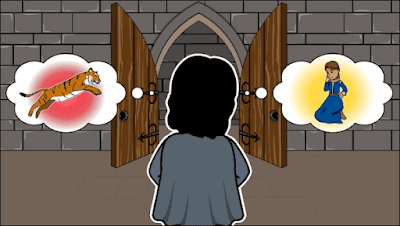
Lady or Tiger

And - once again, because we're Jews - the extra month is generally accepted as Alef Adar Rishon Adar I, not Adar Bet Adar Sheni Adar II. Which is to say: Adar I cuts in line. Wikipedia explains:

Based on a line in the Mishnah declaring that Purim must be celebrated in Adar II in a leap year (Megillah 1:4), Adar I is considered the "extra" month. 
As a result, someone born in Adar during a non leap year would celebrate their birthday in Adar II during a leap year. 
However, someone born during either Adar in a leap year will celebrate their birthday during Adar in a non-leap year, except that someone born on 30 Adar I will celebrate their birthday on 1 Nisan in a non-leap year because Adar in a non-leap year has only 29 days.

It's Easy

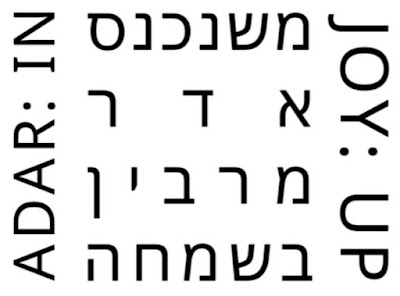
So anyway. As we Jews tell each other every Adar:

Adar In Joy Up

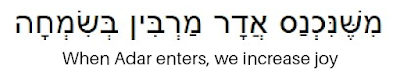
Or, in other words:

When Adar Enters

Therefore, Abq Jew is happy to present Trina Emig (banjo), Trina Emig (bass), Trina Emig (mandolin), Trina Emig (guitar), and Trina Emig (fiddle), playing the old fiddle tune Soldier's Joy.


Want to find out how she did this? Click here.

It's True Ma

Monday, December 11, 2023

Sour Cream and Apple Sauce

A Festival of Light Calculation: This year (5784/2023), our Hanukkah Festival of Lights began on Thursday evening, December 7. Just as three years ago (5781/2020), Hanukkah/Chanukah/Xanuqa began on Thursday evening, December 10. Surely you remember!

And surely you also remember that Abq Jew wrote about this phenomenon at the time (December 2020's Apple Sauce and Sour Cream). To which you DO NOT have to refer, because Abq Jew has thoughtfully updated that blog post and provided same below. You're welcome!

Now, as then, as we do every year -

Mr & Mrs Abq Jew wish you the happiest of holidays!

Now, if you're a former engineer like Abq Jew - first of all, his condolences. Life in the high-technology mines of Silicon Valley, TPC (The Phone Company), and Big Pharma, Abq Jew recalls, was nothing - absolutely nothing - like Workin' In the Coal Mine. Or like Workin' On a Chain Gang.

Hanukkah First Night

 But still.

One of the perpetual residual effects of an an engineering career, it appears, is a fascination with, you should certainly not excuse the expression in our current anti-science climate ... 

Big Data
Data.

This malady has afflicted Abq Jew since he can remember, which, these days, is not as long a period as it once was. On the other hand, Abq Jew can remember all the words to the Cal (UC Davis) Aggie Drinking Song, but ... 

What was Abq Jew talking about?

Chanukah White Sands

Oh yes. Chanukah. Which started on a Thursday night this year. Which you might not think was too extraordinary. You might even think that Hanukkah would start on a Thursday night, oh, about one seventh (14.2857%) of the time.

But you'd be wrong. In fact -

Before 5781/2020,
Xanuqa hadn't started on a Thursday night in 20 years.

And how, you may ask, does Abq Jew know this? Because one of Abq Jew's Facebook friends, Rabbi Gary Gans (see Remembering Jim Croce, MOT) follows the Facebook page Hebrew Calendar Facts. Which Abq Jew now follows, too.

Now, Abq Jew has, on more than one occasion, blogged about the delights and idiosyncrasies of Ye Olde Hebrew Calendar - see, for example, Easter On Purim and Nineteen and Twenty-Eight.

And, Abq Jew has, on more than one occasion, blogged about the fact that

It's Complicated

It's Complicated.

So, Abq Jew would very much like to tell you that his new friend (about whom Abq Jew knows virtually nothing) Hebrew Calendar Facts 

Hebrew Calendar Facts
Signal fires for the New Month

has uncomplicated the heck out of Ye Old Hebrew Calendar and made it simple to understand. At least, to understand why Chanukah hadn't started on a Thursday night in 20 years. But ... alas ... we'll work with what we've got. 

Direct from the Hebrew Calendar Facts Facebook page. With Abq Jew's minor edits for readability (hah!).

Chanukah begins on Thursday night.

Those words had not been heard in 20 years!

Why is it so rare for Chanukah to start on Thursday night (1st day of Chanukah on Friday), and what are the consequences?

There are 4 days of the week when Rosh Hashanah can fall (Monday, Tuesday, Thursday, Shabbat), and as a result, every date from Adar (II) through Cheshvan (which includes all of the major and some minor holidays) is also locked into 4 possible days of the week.  

(For example, Shavuot is always 1 day of the week earlier than the upcoming Rosh Hashanah, so it can fall on Sunday, Monday, Wednesday, or Friday.)  

Latkes Apple Sause Sour Cream

But Chanukah has a wider range, because Cheshvan (the month before Chanukah) can have either 29 or 30 days.  

  • In “applesauce years” (with 355 or 385 days), when Cheshvan has 30 days (about 45% of all years), the 1st day of Chanukah is exactly 12 weeks after Rosh Hashanah, so it’s on the same day of the week as Rosh Hashanah.  
  • In “sour cream years” (with 353, 354, 383, or 384 days), when Cheshvan has 29 days (about 55% of all years), the 1st day of Chanukah is one day earlier, on the same day of the week as the preceding Shavuot.

Combining the possible days of the week listed above for Rosh Hashanah and Shavuot, one might think that Chanukah could start on all 7 days of the week.  

But this isn’t quite true, because years starting on Tuesday always have 354 or 384 days, so Cheshvan always has 29 days, so they’re always sour cream years and Chanukah starts on Monday (not Tuesday).  

So there are 6 possible days of the week for the 1st day of Chanukah: everything except Tuesday.  

(Monday is the most common start day for Chanukah, being the only day of the week that both Rosh Hashanah and Shavuot can fall on, so it’s the only start day that appears in both applesauce and sour cream years.)

NOTE: Why can’t Cheshvan have 30 days in years starting on Tuesday?  If it’s a non-leap year, then counting 355 days from Tuesday means the following year starts on Sunday, which is not an allowed day for Rosh Hashanah.  But in a leap year, 385 days is exactly 55 weeks, so the following year would also start on Tuesday, which is an allowed day, so one might think that this would be possible.  

Here’s why it doesn’t happen:  13 lunar months comes out to about 383.9 days, so a leap year with no delays at either end will have either 383 or 384 days.  The way to get the 385-day year is if Rosh Hashanah is delayed at the end of the year.  

For example, if the year starts on Thursday, then the molad of Tishrei at the end of the year might fall on Wednesday, but Rosh Hashanah can’t fall on Wednesday, so the following RH would be delayed to Thursday, for a total of 385 days.  

But if the year started on Tuesday, then there would be no need for this delay at the end of the year, because Monday is a perfectly cromulent day for the following Rosh Hashanah.

So let’s talk about Chanukah starting on Friday (what we had three years ago, and what we have this year).  Ok, it’s actually not THAT rare.  This happens in 10.1% of all years, which is only a little bit less than what you’d expect if all 7 days of the week had equal probabilities.  

The reason it’s less than 1/7 is because Chanukah starts on Friday in sour cream years that start on Shabbat, and years starting on Shabbat are more likely to be applesauce years (65%) than sour cream years (35%).  

(This is because you can’t have a 354-day year starting on Shabbat, since that would put the following Rosh Hashanah on Wednesday, and 353-day years are comparatively rare, since 12 lunar months are about 354.4 days, so the 353-day year only happens when Rosh Hashanah is delayed at the front end.  

Leap years starting on Shabbat are more evenly split, and there are actually more total sour cream years starting on Shabbat in leap years than in non-leap years, even though leap years in general are less common.)

So on average, Chanukah starts on Friday about once per decade.  But the distribution is not uniform; they can clump together.  Most recently before this year, it happened in 1969, 1972, 1976, 1996, 2000, and 2020.  After this year (2023), it will happen again in 2040, 2047, 2067, 2070, and 2074.  

So in 2020, we were coming out of a 20-year gap, and as you can see, these 20-year gaps are not uncommon.  In 2020 we also had Rosh Hashanah on Shabbat for the first time in 11 years, but before that (in 2002, 2003, 2006, and 2009), we had a bunch of years with Rosh Hashanah on Shabbat, but those were all applesauce years, so Chanukah started (and ended) on Shabbat.  

(Figuring out why these longer gaps are so often exactly 20 years is left to the reader as an exercise.  We haven’t delved into this yet, so please let us know if you come up with an explanation before we do.)

Ok, but what is the significance of Chanukah starting on Friday???  (Our readers who are Torah readers have been waiting very patiently for this paragraph.)  

It’s the only time that Shabbat Mikeitz doesn’t fall during Chanukah!  Since the Shabbat during Chanukah has a special haftarah, this means that the regular haftarah for Mikeitz was read in 2020 for the first time in 20 years!  It’s a very well-known story (where King Solomon says to cut the baby in half), yet rarely read in public.

Why is this the only time that Mikeitz isn’t during Chanukah?  As we said above, the 1st day of Chanukah is either exactly 12 weeks after Rosh Hashanah or one day before that.  

This means that the 1st day of Chanukah is either exactly 9 weeks after Shemini Atzeret or one day before that.  If Shemini Atzeret is on a weekday, then the Shabbat that comes a few days later is Shabbat Bereishit.  9 weeks after that would be the Shabbat that falls in the middle of Chanukah, and 9 weeks after the 1st parashah would be the 10th parashah, which is Mikeitz.  

But if Shemini Atzeret is on Shabbat, then Bereishit is an entire week later.  So the Shabbat that is 9 weeks after Shemini Atzeret is only 8 weeks after Bereishit, so it’s the 9th parashah, which is Vayeishev.  

In an applesauce year, that Shabbat is the 1st day of Chanukah, but then there’s another Shabbat on the 8th day of Chanukah, and THAT Shabbat is Mikeitz.  

But in a sour cream year (like this year), Chanukah starts one day before that Shabbat, and then the 2nd day of Chanukah is Shabbat Vayeishev, and then the 8th day of Chanukah is Friday again, and then the following day (Shabbat Mikeitz) is after the end of Chanukah!

See It's Simple

As you probably heard in 2013 (the “Thanksgivukkah” year), Thanksgiving will not fall entirely during Chanukah again (until the calendar loops all the way around).  

However, we’ll have a couple more times when the 1st NIGHT of Chanukah falls on the night of Thanksgiving, in 2070 and 2165.  

Since (by definition) those are years (like this year) when Chanukah starts on a Thursday night, those future Thanksgivukkah years will also be years when Mikeitz is not during Chanukah!

Happy Chanukah to all!

Aha! Abq Jew hears you, his loyal readers, exclaim. This cogent, coherent explanation is marvelous! 

True Truth

But is it true?

Or is it just some really, really good Razzle Dazzle? There are two things (in this very limited context) of which Abq Jew is sure:

1.
Don't Know

2.
Happy Hanukkah


Thursday, June 22, 2023

Let's Twist Again!

A Valley Stream Bar Mitzvah Update: Let's continue last week's Chubby Checker story (see Celebration With a Twist) with a few updates. In April 2019 Abq Jew wrote:

Abq Jew and his parents, of blessed memory, lived on the bottom floor of 35 Gibson Blvd, Valley Stream, from 1956 through 1962. Abq Jew's grandparents, also of blessed memory, lived on the top floor.

A joint purchase, Abq Jew surmises. Maybe ... $10,000 each? Less (GI Bill)? Today worth $560,204, Zi
llow says.
Valley Stream Map

Well, that was then. Zillow now says Abq Jew's ancestral home is worth $745,000 on the open market. But then again - it's a duplex, so one other family gets to share in the excitement of owning a 70-year-old house.

And that $10,000 each? Not a bad guess. John F reports that his family chipped in $12,500 x 2 for their purchase. And that their price included an extra $1,000 so their new home was next door to Abq Jew's parents' - across the street from (not next to) the LIRR tracks.


Sunrise Jewish Center, the Orthodox shul on Rockaway Avenue that Abq Jew's parents helped found - where Abq Jew celebrated his Bar Mitzvah - well, it's now Chabad of Valley Stream, North Woodmere, East Rockaway, and Lynbrook. But it's still there!

The rabbi at Abq Jew's Bar Mitzvah was Theodore Jungreis, husband of the much-more-famous Rebbetzin Esther Jungreis. Shortly after Abq Jew's Bar Mitzvah. Rabbi & Rebbitzen left Sunrise and moved to North Woodmere (one of Long Island's "Five [Rich] Towns"), where they, shall we say, did well.


And then - for the record - there's Congregation Beth David, the Conservative synagogue now in Saratoga, California that Abq Jew's parents also helped found - where Abq Jew pre-celebrated his Bar Mitzvah.

At some point, what became Beth David started meeting in a white house on El Camino Real, close to Downtown Sunnyvale. Abq Jew had a nice Friday-night Bar Mitzvah going-away celebration at the white house in June 1963.

Shabbat Rosh Chodesh

So let's talk about
Shabbat Korach Rosh Chodesh Tammuz.

As mentioned last week, Abq Jew's Bar Mitzvah date turned out to be Shabbat Korach of the year 5723, which also turned out to be Rosh Chodesh Tammuz of that year (1963).


Since that day, we Jews have read Parshat Korach 60 times in the Land of Israel and 59 times here in the Diaspora. (The 60th time will be, G-d willing, this coming Shabbat, June 24.)
 
142

But since that day, we Jews have read the Haftarah for Shabbat Rosh Chodesh 142 times. (The 142nd time was Shabbat Tazria-Metzora, April 22, 2023.) 

Which, to what is left of Abq Jew's mind after too many years of technical writing, raises the question -

How come

Hebrew Calendar

The answer lies in the delightful yet
mysterious intricasies of the Hebrew Calendar.

First of all - Abq Jew strongly recommends that , at a minimum, you review these blog posts what he has written about the complexities of the Hebrew Calendar:

WARNING: Reviewing these blog posts will not help you understand the magic behind Shabbat Rosh Chodesh. On the other hand - it couldn't hurt!

Here's something that will help you understand aforementioned magic: Mathematics of the Jewish Calendar. Where it says (abbreviated):

There are fourteen possible types of year.

A year may not start on Sunday, Wednesday or Friday. Thus it may start on any of four weekdays (Monday, Tuesday, Thursday or Saturday). There can at most be 24 year types.

Of these, nine are obviously impossible because they would cause the next Rosh Hashana to fall on a forbidden weekday. And one possible type of leap year can never happen.

This leaves fourteen possible year types, and they all do occur.

Then we turn to what Mathematics says (abbreviated) about Shabbat Rosh Chodesh:

Shabbat Rosh Chodesh is a Shabbat that falls on Rosh Chodesh. 

There are two such Shabbats in every Hebrew year type, and three in six certain types.

In four year types, Rosh Chodesh Tishrei is also Shabbat, but that is Rosh Hashanah, so does not count as Shabbat Rosh Chodesh.

Tachlis

Abq Jew (thank you, HebCal.com!) looked at the Civil Calendars for the years 1963 through 2024. And discovered:

Twelve years in which there was but one Shabbat Rosh Chodesh. (Remember: these are civil years, not Hebrew years.) In every case, it was Shabbat Rosh Chodesh Iyar, and the Torah reading was Tazria-Metzora.

Fifteen years in which there were two Shabbats Rosh Chodesh. Several Nisan-Elul combinations; a few Shevat-Iyars; others were one-offs.

Thirty-five years in which there were three Shabbats Rosh Chodesh. Many Shvat-Tammuz-Cheshvan combinations; several Adar I-Tammuz-Cheshvans; some Nisan-Elul-Tevets.

Tammuz and Cheshvan were the most popular Shabbats Rosh Chodesh. In all cases, they are a two-fer; in many cases they are a three-fer with Shevat. 

There was never a Shabbat Rosh Chodesh Sivan or a Shabbat Rosh Chodesh Kislev. 

Since (and including) 1963, there have been nineteen Shabbat Korach Rosh Chodesh Tammuzes. The last Shabbat Korach Rosh Chodesh Tammuz was in 2017; the next Shabbat Korach Rosh Chodesh Tammuz will be in 2024.

Isaiah the Prophet

If you're going to learn but one Haftarah (say,
for your Bar Mitzvah, Bat Mitzvah, or Aufruf),
Isaiah's Shabbat Rosh Chodesh would give you
the most bang for the buck. Just sayin'.

One more thing

Remember last week when Abq Jew said that someplace, he has photos of his Chubby Checker Bar Mitzvah celebration of June 1963?

BM1

BM2

Found them

Monday, December 14, 2020

Apple Sauce and Sour Cream

A Festival of Light Calculations: This year (5781/2020), our Festival of Lights (Hanukkah/Chanukah/Xanuqa) began on Thursday evening, December 10.

Mr & Mrs Abq Jew wish you the happiest of holidays!

Now, if you're a former engineer like Abq Jew - first of all, his condolences. Life in the high-technology mines of Silicon Valley, TPC (The Phone Company), and Big Pharma, Abq Jew recalls, was nothing - absolutely nothing - like Workin' In the Coal Mine. Or like Workin' On a Chain Gang.

Hanukkah First Night

 But still.

One of the perpetual residual effects of an an engineering career, it appears, is a fascination with, you should certainly not excuse the expression in our current anti-science climate ... 

Big Data
Data.

This malady has afflicted Abq Jew since he can remember, which, these days, is not as long a period as it once was. On the other hand, Abq Jew can remember all the words to the Cal (UC Davis) Aggie Drinking Song, but ... 

What was Abq Jew talking about?

Chanukah White Sands

Oh yes. Chanukah. Which started on a Thursday night this year. Which you might not think was too extraordinary. You might even think that Hanukkah would start on a Thursday night, oh, about one seventh (14.2857%) of the time.

But you'd be wrong. In fact -

Xanuqa hasn't started on a Thursday night in 20 years.

And how, you may ask, does Abq Jew know this? Because one of Abq Jew's Facebook friends, Rabbi Gary Gans (see Remembering Jim Croce, MOT) follows the Facebook page Hebrew Calendar Facts. Which Abq Jew now follows, too.

Now, Abq Jew has, on more than one occasion, blogged about the delights and idiosyncrasies of Ye Olde Hebrew Calendar - see, for example, Easter On Purim and Nineteen and Twenty-Eight.

And, Abq Jew has, on more than one occasion, blogged about the fact that

It's Complicated

It's Complicated.

So, Abq Jew would very much like to tell you that his new friend (about whom Abq Jew knows virtually nothing) Hebrew Calendar Facts 

Hebrew Calendar Facts
Signal fires for the New Month

has uncomplicated the heck out of Ye Old Hebrew Calendar and made it simple to understand. At least, to understand why Chanukah hasn't started on a Thursday night in 20 years. But ... alas ... we'll work with what we've got. 

Direct from the Hebrew Calendar Facts Facebook page. With Abq Jew's minor edits for readability (hah!).

Chanukah begins on Thursday night.

Those words have not been heard in 20 years!

Why is it so rare for Chanukah to start on Thursday night (1st day of Chanukah on Friday), and what are the consequences?

There are 4 days of the week when Rosh Hashanah can fall (Monday, Tuesday, Thursday, Shabbat), and as a result, every date from Adar (II) through Cheshvan (which includes all of the major and some minor holidays) is also locked into 4 possible days of the week.  

(For example, Shavuot is always 1 day of the week earlier than the upcoming Rosh Hashanah, so it can fall on Sunday, Monday, Wednesday, or Friday.)  

Latkes Apple Sause Sour Cream

But Chanukah has a wider range, because Cheshvan (the month before Chanukah) can have either 29 or 30 days.  

  • In “applesauce years” (with 355 or 385 days), when Cheshvan has 30 days (about 45% of all years), the 1st day of Chanukah is exactly 12 weeks after Rosh Hashanah, so it’s on the same day of the week as Rosh Hashanah.  
  • In “sour cream years” (with 353, 354, 383, or 384 days), when Cheshvan has 29 days (about 55% of all years), the 1st day of Chanukah is one day earlier, on the same day of the week as the preceding Shavuot.

Combining the possible days of the week listed above for Rosh Hashanah and Shavuot, one might think that Chanukah could start on all 7 days of the week.  

But this isn’t quite true, because years starting on Tuesday always have 354 or 384 days, so Cheshvan always has 29 days, so they’re always sour cream years and Chanukah starts on Monday (not Tuesday).  

So there are 6 possible days of the week for the 1st day of Chanukah: everything except Tuesday.  

(Monday is the most common start day for Chanukah, being the only day of the week that both Rosh Hashanah and Shavuot can fall on, so it’s the only start day that appears in both applesauce and sour cream years.)

NOTE: Why can’t Cheshvan have 30 days in years starting on Tuesday?  If it’s a non-leap year, then counting 355 days from Tuesday means the following year starts on Sunday, which is not an allowed day for Rosh Hashanah.  But in a leap year, 385 days is exactly 55 weeks, so the following year would also start on Tuesday, which is an allowed day, so one might think that this would be possible.  

Here’s why it doesn’t happen:  13 lunar months comes out to about 383.9 days, so a leap year with no delays at either end will have either 383 or 384 days.  The way to get the 385-day year is if Rosh Hashanah is delayed at the end of the year.  

For example, if the year starts on Thursday, then the molad of Tishrei at the end of the year might fall on Wednesday, but Rosh Hashanah can’t fall on Wednesday, so the following RH would be delayed to Thursday, for a total of 385 days.  

But if the year started on Tuesday, then there would be no need for this delay at the end of the year, because Monday is a perfectly cromulent day for the following Rosh Hashanah.

So let’s talk about Chanukah starting on Friday (what we have this year).  Ok, it’s actually not THAT rare.  This happens in 10.1% of all years, which is only a little bit less than what you’d expect if all 7 days of the week had equal probabilities.  

The reason it’s less than 1/7 is because Chanukah starts on Friday in sour cream years that start on Shabbat, and years starting on Shabbat are more likely to be applesauce years (65%) than sour cream years (35%).  

(This is because you can’t have a 354-day year starting on Shabbat, since that would put the following Rosh Hashanah on Wednesday, and 353-day years are comparatively rare, since 12 lunar months are about 354.4 days, so the 353-day year only happens when Rosh Hashanah is delayed at the front end.  

Leap years starting on Shabbat are more evenly split, and there are actually more total sour cream years starting on Shabbat in leap years than in non-leap years, even though leap years in general are less common.)

So on average, Chanukah starts on Friday about once per decade.  But the distribution is not uniform; they can clump together.  Most recently before this year, it happened in 1969, 1972, 1976, 1996, and 2000.  After this year (2020), it will happen again in 2023, 2040, 2047, 2067, 2070, and 2074.  

So we’re coming out of a 20-year gap, and as you can see, these 20-year gaps are not uncommon.  This year we also had Rosh Hashanah on Shabbat for the first time in 11 years, but before that (in 2002, 2003, 2006, and 2009), we had a bunch of years with Rosh Hashanah on Shabbat, but those were all applesauce years, so Chanukah started (and ended) on Shabbat.  

(Figuring out why these longer gaps are so often exactly 20 years is left to the reader as an exercise.  We haven’t delved into this yet, so please let us know if you come up with an explanation before we do.)

Ok, but what is the significance of Chanukah starting on Friday???  (Our readers who are Torah readers have been waiting very patiently for this paragraph.)  

It’s the only time that Shabbat Mikeitz doesn’t fall during Chanukah!  Since the Shabbat during Chanukah has a special haftarah, this means that the regular haftarah for Mikeitz will be read this year for the first time in 20 years!  It’s a very well-known story (where King Solomon says to cut the baby in half), yet rarely read in public.

Why is this the only time that Mikeitz isn’t during Chanukah?  As we said above, the 1st day of Chanukah is either exactly 12 weeks after Rosh Hashanah or one day before that.  

This means that the 1st day of Chanukah is either exactly 9 weeks after Shemini Atzeret or one day before that.  If Shemini Atzeret is on a weekday, then the Shabbat that comes a few days later is Shabbat Bereishit.  9 weeks after that would be the Shabbat that falls in the middle of Chanukah, and 9 weeks after the 1st parashah would be the 10th parashah, which is Mikeitz.  

But if Shemini Atzeret is on Shabbat, then Bereishit is an entire week later.  So the Shabbat that is 9 weeks after Shemini Atzeret is only 8 weeks after Bereishit, so it’s the 9th parashah, which is Vayeishev.  

In an applesauce year, that Shabbat is the 1st day of Chanukah, but then there’s another Shabbat on the 8th day of Chanukah, and THAT Shabbat is Mikeitz.  

But in a sour cream year (like this year), Chanukah starts one day before that Shabbat, and then the 2nd day of Chanukah is Shabbat Vayeishev, and then the 8th day of Chanukah is Friday again, and then the following day (Shabbat Mikeitz) is after the end of Chanukah!

See It's Simple

As you probably heard in 2013 (the “Thanksgivukkah” year), Thanksgiving will not fall entirely during Chanukah again (until the calendar loops all the way around).  

However, we’ll have a couple more times when the 1st NIGHT of Chanukah falls on the night of Thanksgiving, in 2070 and 2165.  

Since (by definition) those are years (like this year) when Chanukah starts on a Thursday night, those future Thanksgivukkah years will also be years when Mikeitz is not during Chanukah!

Happy Chanukah to all!

Aha! Abq Jew hears you, his loyal readers, exclaim. This cogent, coherent explanation is marvelous! 

True Truth

But is it true?

Or is it just some really, really good Razzle Dazzle? There are two things (in this very limited context) of which Abq Jew is sure:

1.
Don't Know

2.
Happy Hanukkah