Monday, November 7, 2022

Train Wreck at Federation

Hope For The Future: As many of us New MexiJews recall, January 28, 2013 was not a good day for the Jewish Family Service of New Mexico (JFSNM). And it was a terrible day for the New Mexico Jewish Community. That was the day that the JFSNM Board announced that the organization would soon cease operations.

As many of us New MexiJews recall, January 13, 2015 was not a good day for the Jewish Academy of Arts & Sciences. And it was a terrible day for the New Mexico Jewish Community. That was the day that the Jewish Academy Board announced that the school would soon cease operations.
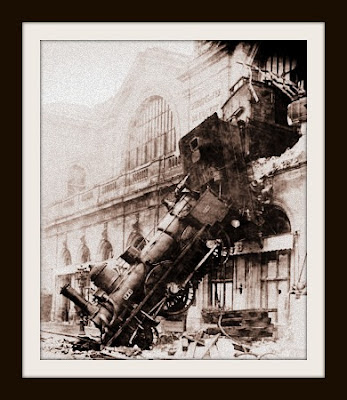
Train Wreck

But now, as many of us New MexiJews are suddenly aware, November 4, 2022 - last Friday - was not a good day for the Jewish Federation of New Mexico. And it was a most terrible day for the New Mexico Jewish Community.

Worse than the closing of the Jewish Family Service of New Mexico (JFSNM). Worse than the closing of the Jewish Academy of Arts & Sciences. 

The absolute worst.

Last Friday, many of us New MexiJews received this email letter from Robert Efroymson, President of the Jewish Federation of New Mexico (JFNM).

Dear members of the New Mexico Jewish Community,  

 I am proud to have recently been elected President of the Jewish Federation of New Mexico by its board of directors. The Federation has played an important role in the life of Jewish New Mexico for decades. However, I must be blunt: my tenure will be a short one. The main task we face is an orderly shutdown of the organization. 

There have been news articles and rumors aplenty, so I will be brief, and make only a few points. We are almost out of money. We have no employees. Critical insurance has been canceled. We cannot fulfill the purposes for which the organization was founded. 

 You might ask if we can recover. Surely, we can raise money again, hire new employees, get another insurance carrier? That might be true, but we must be honest. Decisions made by the prior leadership of the organization have placed us in a very poor position.  It is regrettable that it has been months since the former Executive Director sent his “report” to the community.  It is also regrettable that it was sent. 

I would like to say more about how we came to this pass. The truth is that there is much we still don’t know. One of the chief tasks the board has undertaken is to conduct an independent accounting review so we can report to the community what has happened.   

 In the meantime, I would ask members of the community to continue the charitable activities which the JFNM has historically facilitated. The Jewish Care program is now under the auspices of the Jewish Community Center, and money to support it can be directed to them. Organizations like UNM Hillel and others that previously were supported by JFNM can accept contributions directly.  

 There are many other charities that we have supported, both locally and internationally, over the years. You will have your favorites among them, and I urge you to look up the best way to give. Now is an excellent time to contact the Jewish Community Foundation about setting up a Donor Advised Fund.  

 I know this is not the news you wanted to hear. We will communicate further as we have more information. 

Robert Efroymson
President, JFNM 

Many of you have known for months that things were not good at the Jewish Federation. But many of you may not have been informed, may not have read about it, and therefore may not have known. 

And now, the Big Question seems to be

What's Going On Here

The first thing you may have noticed is that the Jewish Federation of New Mexico's website is down, and has been down for a while.

JFNM Website

One immediate effect of JFNM's "temporary maintenance" period is:

 The Jewish New Mexico's Community Calendar of events and classes,
which is powered by Abq Jew and shared with the Jewish Federation,
appears to be unreachable.

Therefore, let Abq Jew assure you:

The complete Community Calendar is always
available on Abq Jew's website, right here.

Abq Jew Community Calendar

But that, as we are now all aware -

Tip of the Iceberg

was just the tip of the iceberg.

Where JFNM?

The Jewish Federation of New Mexico
was in trouble. Deep trouble.

JTA Logo

To begin to understand what has happened and (at least, to some extent) why, Abq Jew points you, his loyal readers, to a series of three articles written by JTA's Asaf Elia-Shalev.

Sephardic citizenship bids at risk amid ‘implosion’
of New Mexico’s Jewish community leadership
March 30, 2022

Read More


New Mexico’s Jewish federation is on brink of collapse
with no staff or funding for programs
September 19, 2022

Read More


Three
New Mexico’s cash-strapped, lawsuit-plagued
Jewish federation announces closure
November 4, 2022

Read More

At this point, Abq Jew is sure that many of you are asking -

What, Abq Jew hears you ask, is gonna happen next? To which Abq Jew can only reply, in the now-famous words of Tevye der Milkhiker -

Don't Know

However -

In the past few weeks, a new JFNM Executive Board has taken office, and some progress has been made.

Want to help your favorite programs?
Please contribute to them directly.

  • And, as stated above, 

The complete Community Calendar is always
available on Abq Jew's website, right here.

Abq Jew Community Calendar

Abq Jew chooses to conclude with the hopeful words of Shelly Prant, Executive Director of the Jewish Community Center of Greater Albuquerque - as reported by JTA's Asaf Elia-Shalev in his September 19, 2022 article. 

... she believes the community will rally to ensure essential programs will continue and that her organization and others are prepared to pick up any slack created by the problems at the federation.

“There’s a core group of people in Albuquerque and around the state that are really caring, passionate and philanthropic,” Prant said. 
“And they’re really taking all this very seriously and trying to help, and so at the end of the day, we’ll be okay even though right now, it is challenging.”
OK In The End


Tuesday, November 1, 2022

Remembering Mike Patterakis

A Fight Song, A Love Song: Once upon a time, many years ago, Abq Jew attended Peterson High School in Sunnyvale, California, Home of the Pirates. During football season, he was a proud alto sax player in the Marching Band. And during basketball season, he was the proud leader of the Pep Band. 

And Abq Jew was also the founder, leader, banjo player, and vocalist (no one else knew the lyrics) for the Motherhood and Apple Pie Skiffle Band. He was proud of that, too - we were "in demand" in the Bay Area folk music scene.

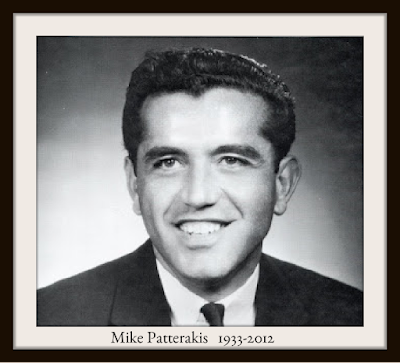
Mike Patterakis

Behind all that love for music was Mike Patterakis, the Music Director at Peterson High School in Sunnyvale, California. Abq Jew was far from the only student who felt that way. - just about everyone loved Mr Patterakis. (Everyone loved Mr Baer, too - see October 2017's A Paean to Mr Baer).

So. One day last week, as Abq Jew was doing ... research ... on the Web, he came across the following comment and question in his Peterson High School Facebook Group:

I was watching college football the other day, passively listening to a college marching band play their  fight song. It prompted the question, 

“Where did the Peterson High School Fight Song come from?” 

It’s no secret that high school fight songs are adopted from colleges. For instance, Buchser High School used “On, Wisconsin.” Sunnyvale High School used the United States Air Force song. 

So, how about the Peterson Fight Song? Perhaps, some of our band alumni know the answer. The song itself has been rattling around, in my head.

The answer quickly came back:

Mr Patterakis wrote it. 

Well. Of course he did. And Abq Jew added his memories to that simple statement:

Yes, Mr Patterakis wrote the fight song. I remember (I was in the band) discussing the chord progressions with him. I did make one suggestion for improvement [switching a dominant chord to a subdominant], which he agreed was musically correct. But he never changed it. 

And, for the record, 'twas I who wrote the fanfare that introduced the marching band. Yes, Mr Patterakis was a great guy. One of a kind, of blessed memory.

I also remember creating a bluegrass banjo version of the fight song. Dear Lord, what memories. BTW, I'm Class of '68.

And then things got really interesting. Another of Mr Patterakis's more knowledgeable students wrote:

Mr Patterakis used the tune from a Greek folk song, and then wrote the words to fit. Here it is.

"Aha!" said Abq Jew. And did more Web research, then wrote back:

Wow! I never knew that! I went to your YouTube link and ... my God, this is (mostly) our fight song! Thank you for sharing this! 

And here's another video, from world-famous Greek singer Nana Mouskouri, with lyrics: 

Σαμιώτισσα,Samiotissa

Σαμιώτισσα, Σαμιώτισσα, πότε θα πας στη Σάμο
Samiotissa, Samiotissa, pote tha pas sti Samo?
O Samos girl, when will you return to Samos?

As it turns out, Samiotissa is a traditional (Δημοτικό/Παραδοσιακό) song from Samos, one of the Aegean islands of Greece. 

In the eastern Aegean Sea, Samos is separated from Turkey by the mile-wide Mycale Strait - thus making it the closest island to Turkey. 

Samos was the birthplace of Mathematician Pythagoras and Philosopher Epicurus, and is known for producing world famous sweet Muscat wine.

Peterson Pirates

Here is Mr Patterakis's obituary:

MANUEL (MIKE) PATTERAKIS    AUGUST 19, 1933 - APRIL 8, 2012

Manuel (Mike) Patterakis passed away on April 8, 2012 at the Garden City convalescent facility after a lengthy illness. He will be missed by loved ones and friends and is fondly remembered as a talented, thoughtful and caring man. 
Born in Van Houten, New Mexico on August 19, 1933, he moved with his family from Hiawatha, Utah to Modesto in his youth and graduated from Modesto High School before going on to obtain a degree in music from San Jose State University. After two years of army service in Germany, he returned to become a music teacher in the San Jose area. 
His life was marked by an abiding love and devotion to music beginning with participation in his church choir and local high school musical productions, followed by a career as a high school music teacher, and in retirement as a choral director of the Greek Orthodox Church in Stockton. He will be remembered by many in Modesto for his frequent appearances as emcee and singer at the annual food festival of the local Greek Orthodox Church. 
As a teacher he made a real difference in many young lives, and a large number of his former students and faculty from Peterson High School in Sunnyvale, came to Modesto recently to honor him at a joyful and emotional reunion luncheon. 
He is predeceased by father and mother, Gregory and Helen Patterakis, and sister and brother, Grace Capobianco and Col. Chris Patterakis. He is survived by sister-in-law and care-giver, Vicki Patterakis; nieces and nephew, Alicia Rodahaffer, Donna Martin, Patti Perea, Mark Patterakis and their children, godson, George Katsufrakis, and numerous cousins and aunts. 

As mentioned above - on January 7, 2012, many of Mr Patterakis's students visited him - and sang with him. There are lots of videos and more on Facebook's Mike Patterakis Fan Page

The video shown here (courtesy of Meg (Conly) Dondero, Class of '74), presents Mike Patterakis and his students singing the Marian A Peterson High School Alma Mater. Yes, Mr Patterakis wrote that, too. And this may be the only recording of the MAPHS Alma Mater on the Web.

Rebbe Nachman

The concept of simcha (happiness) is an important one in Jewish philosophy.

A popular teaching by Rabbi Nachman of Breslov, a 19th-century Chassidic Rabbi, is "Mitzvah Gedolah Le'hiyot Besimcha Tamid," it is a great mitzvah (commandment) to always be in a state of happiness.

When a person is happy, he is much more capable of serving God and going about his daily activities than when depressed or upset.

Happy is how Abq Jew will always remember Mr Patterakis.
May his memory be for a blessing.

Memory Blessing

Wednesday, October 26, 2022

Noah Votes Blue

Chooses Democracy Every Time: We'll talk about Noah in a second. But first: It's Election Season in America once again! And, as he thinks he does every Election Season, Abq Jew reminds you that

Abq Jew ® is a one-person LLC, not a 501(c)(3).
And is therefore free to talk politics!

That being said - VOTE BLUE!

Vote Blue

OK. Back to Noah.

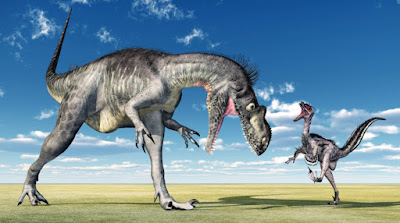
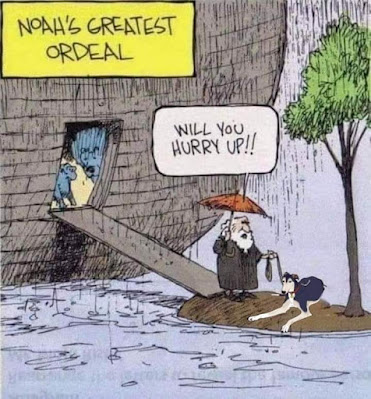
This Shabbat we will again read Parshat Noah, the one portion of the Holy Torah that has us New MexiJews lamenting the tragic loss of Earth's entire dinosaur population, who (quite literally) missed the boat.

 
And we fondly remember our pal, the Stegosaurus.

Stegasaurus
Stegosauruses had beautiful singing voices, and they
knew all the words to The Seekers' greatest hits.

Now, Wikipedia tells us:
Stegosaurus ('roof-lizard') is a genus of herbivorous, four-legged, armored dinosaur from the Late Jurassic, characterized by the distinctive kite-shaped upright plates along their backs and spikes on their tails. Fossils of the genus have been found in the western United States and in Portugal, where they are found in strata dating to between 155 and 145 million years ago.

And furthermore:

Stegosaurus, one of the many dinosaurs described in the Bone Wars [also known as the Great Dinosaur Rush], was first collected by Arthur Lakes and consisted of several caudal vertebrae, a dermal plate, and several additional postcranial elements that were collected north of Morrison, Colorado. 
These first, fragmented bones became the holotype of Stegosaurus armatus when Yale paleontologist Othniel Charles Marsh described them in 1877. 

Dinosaurs

As it turns out, Robert Plot is credited with discovering the first dinosaur bone, but his best guess as to what it belonged to was a giant human. It wasn't until William Buckland, the first professor of geology at Oxford University, that a dinosaur fossil was correctly identified for what it was. In 1824.

So. You remember that time when -

Noah of Arc and his wife, Joan, 
build a boat to survive a great flood.

Neither Noah nor his wife knew about dinosaurs.

Rashi

Neither did Rashi.

Rishi Sunak

Rishi Sunak, the new Prime Minister of the United Kingdom and Leader of the Conservative Party, certainly knows about dinosaurs and their fossils. Several are now members of his Cabinet!

ICYMI - Sefaria tells us:
Rashi (Rabbi Shlomo Itzhaki, 1040-1105) was a medieval French rabbi who wrote a comprehensive commentary on the Tanakh. Rashi's great because he presents the basic meaning of the text in a clear and concise fashion. His comments usually try to answer a burning question that an ordinary reader might have.

But, Rashi only wrote down his answers - NOT the questions! So the first thing to do is always to ask: "What's bothering Rashi?" Once you understand the question Rashi's responding to, his answer will make a lot more sense.
Abq Jew digresses

But Abq Jew digresses. 

Surely you remember (and if she doesn't, please remind her) that it was ten (10) years ago (!) (see Noah! Send Out The Dove!) that Abq Jew first brought you Matti Caspi and Chocolat, Menta, Mastik singing their '70s hit.

And here it is again, and only because a) it is Parshat Noah; and b) this performance reminds Abq Jew of days ... and years ... gone by. Nostalgia.


Parshat Noach. A time to


Send out the dove.


Watch for the plaid in the rainbow.

Stegasaurus

Remember the stegosaurus.

Noah Greyhound

And the greyhound.

Vote Blue

And VOTE BLUE!

Wednesday, October 19, 2022

Goldilocks & The Jews Again

Hello? Exoplanets? Is Anyone There? Here is a Best of Abq Jew Blog post, which Abq Jew first published just in time for Earth Day 2013. 

As it turns out, here in 2022, we have just finished with the fall Jewish Holidays, and this coming Shabbat we will begin to read the Torah all over again - with Parshat Bereshit.

In other words - it's a short week. And Goldilocks & The Jews still seems entirely appropriate.

Best of Abq Jew Blog

The New York Times has published an Earth Day Pop Quiz, which it introduces with:
It makes sense that NASA, the people behind the Kepler mission to find potentially habitable planets, would pay attention to Earth Day (April 22). This year, scientists at NASA’s Jet Propulsion Lab at the California Institute of Technology put together questions on exoplanets — planets beyond our solar system — and what makes Earth so remarkable.
Also, Ben R. Oppenheimer, chairman of the Department of Astrophysics at the American Museum of Natural History, addresses the odds of finding planets like Earth in questions 11 to 14. Are there natural environments like ours? How many might there be? For more information on exoplanets, visit NASA’s PlanetQuest Web site.
First - you must be wondering how Goldilocks got into this discussion. The answer to Question 1 therefore tells us:
A Goldilocks planet falls within a star’s habitable zone and is neither too close nor too far from a star to rule out liquid water on its surface, and thus life. Earth is a Goldilocks planet.
The answer to Question 11 tells us:
Our sun is one of about 200 billion stars in the Milky Way, but it is not typical. In fact, only about 5 percent of stars are similar in mass and luminosity to the sun. There are 10 billion stars in the galaxy similar to our sun.
Question 12 teaches us that:
The maximum number of Earth-size planets orbiting sunlike stars in the galaxy is 2.3 billion.
And them, with further math and a few conservative assumptions, we learn that - of the 150 stars similar to the sun within 70 light-years of our solar system - we could expect 3 or 4 of them to host an Earth-like planet. And yet -

They don't call, they don't write, they don't visit.


This is also what Ross Douthat talks about in his column, Worlds Away From Here. Douthat points out that
we discovered another world last week. Two, actually — both somewhat larger than Earth, circling a star with the sadly unromantic name of Kepler 62, 1,200 light-years away.
These planets are not the first Earth-like bodies astronomers have discovered, but their size and position make them particularly promising candidates to have liquid water — and with it, perhaps, some form of life.

But their promise only adds to a mystery that’s been building the further our probes and telescopes have pushed into the unknown. If Earth-like planets are relatively common, as scientists increasingly believe, then
Where are all the Earth-like civilizations?
Douthat continues:
This mystery is known as the Fermi paradox, after the physicist Enrico Fermi, who raised it at lunch with fellow scientists in 1950. He pointed out that our Sun is a relatively young star, and billions of other suns are billions of years older. If even a tiny fraction of those suns have planets like ours, and even a tiny fraction of those planets developed life, and even a tiny fraction of those life forms achieved human-level intelligence ... well, the number of civilizations capable of interstellar communication and travel should be theoretically large enough to crowd our galaxy with signals, ships, artifacts.

In which case, Fermi asked,
Where is everybody?

If you look up Fermi paradox in Wikipedia, you'll see that the suite of possible explanations runs to just over 10,000 words. (Douthat counted; Abq Jew didn't.)  The article begins:
The Fermi paradox (or Fermi's paradox) is the apparent contradiction between high estimates of the probability of the existence of extraterrestrial civilization and humanity's lack of contact with, or evidence for, such civilizations. The basic points of the argument, made by physicists Enrico Fermi and Michael H. Hart, are:
  • The Sun is a young star. There are billions of stars in the galaxy that are billions of years older; 
  • Some of these stars likely have Earth-like planets[2] which, if the Earth is typical, may develop intelligent life; 
  • Presumably some of these civilizations will develop interstellar travel, a technology Earth is investigating even now; 
  • At any practical pace of interstellar travel, the galaxy can be completely colonized in a few tens of millions of years.
According to this line of thinking, the Earth should have already been colonized, or at least visited. But no convincing evidence of this exists. Furthermore, no confirmed signs of intelligence elsewhere have been spotted, either in our galaxy or the more than 80 billion other galaxies of the observable universe. Hence Fermi's question:
Where is everybody?

And what, Abq Jew hears you ask, does this have to do with us Jews? For one answer, let's turn to the Virtual Beit Midrash. In a shiur (lesson) on Parshat Bereishit, Rav David Silverberg notes:
The Midrash in Bereishit Rabba (3:7; 9:2) cites the comment of Rabbi Avahu that the Almighty created numerous universes prior to the creation of the world we know. Each time He created a universe, He destroyed it. The Midrash explains that Rabbi Avahu extracted this theory from the verse in Parashat Bereishit (1:31), which tells that after creation, "God saw all that He made, and behold, it was very good." The word "ve-hinei" ("and behold") suggests a novelty of some sort, that this creation, as opposed to God's previous "attempts," was "very good."
Wait a minute! Abq Jew hears you cry. Does this mean that the Holy One Blessed Be He had to go through some trials and errors before He got it right? (Trials we can accept, Abq Jew claims. But errors? One world was too hot; one world was too cold; but our Goldilocks Earth was just right?

It turns out that this ... possibility ... also bothered Rabbi Joseph B Soloveitchik zt"l, aka The Rav. As we read in last week's double parsha,

You shall be holy, for I, the Lord your God, am holy.

In other words - we are to imitate God. And how can we possibly even attempt to do that? Hama bar Hanina, interpreting the verse "After the Lord your God you shall walk" (Deuteronomy 13: 5), teaches us:
Just as God clothes the naked, so you shall clothe the naked. Just as God visits the sick, so you shall visit the sick. Just as God comforts the bereaved, so you shall comfort the bereaved. Just as He buries the dead, so you shall bury the dead."
Rav Silverberg continues:
A famous concept in Judaism teaches that to whatever extent possible, we must follow God's lead and imitate His conduct. The Torah and Chazal depict for us God's "conduct" in anthropomorphic terms so that we can behave in our lives in a manner similar to His behavior.
In his famous essay, "The Lonely Man of Faith," Rav Soloveitchik develops the idea that this obligation to imitate God extends to God's capacity to create, as well. We are to build, create and produce in the world, just as the Almighty Himself built and created and produced the universe.
The Rav claimed that this is what is meant by the concept of "tzelem Elokim," that man is created in the "image of God" (see Bereishit 1:26-27). Man resembles God in that he, too, is endowed with this creative power. The obligation to follow God's lead thus includes the responsibility to build and develop.

This would then explain why, as the Midrash records, God built and destroyed several worlds before creating the world we know ... God taught us a critical lesson about the art of building: sometimes, we make mistakes and must start again.
Well before the universe was created, God saw to it that mankind would not become discouraged after failure. It goes without saying that God could have "gotten it right" the first time around. But He wished for us to learn that in the process of building and growing, we will often encounter setbacks that mustn't deter us from pursuing our goals.
As we go through life, we will all make mistakes – some bigger and more consequential than others. When we commit these mistakes, we must have the courage to "destroy the worlds," to change course and start anew, to try again, to continue building.
This is the message of the universes that were created and destroyed, of the worlds that God created to show us the importance of moving forward even after suffering a setback.
So, where are we now?
  • We've got worlds out there that don't call, don't write, don't visit. 
  • We've got one Goldilocks Earth right here that God expended a good deal of time and effort to create. 
  • And we have the Jewish principle that we should be more like God.

 In a statement about Environmental Ethics in Judaism, the New South Wales Board of Jewish Education (Abq Jew loves the Internet!) states:
From Bereshit (Genesis 1:28), the first chapter in the Torah, we see that God wants human beings to both use the natural world for their needs but at the same time to preserve the world and prevent its destruction. We need to work out how to achieve both. Destroying anything in the world needlessly is called ‘Bal tashchit’in Hebrew and Jews are commanded “not to cause any damage or loss”.

Any use of the natural world or its resources that satisfies a legitimate human need is not considered destructive. A monetary benefit is considered a human need. This was agreed to and codified as law by Maimonides. Also, when the environment would be harmed without destruction taking place, it becomes legitimate. If when performing a mitzvah destruction occurs, it is considered legitimate. Two examples of this are the tearing of one’s shirt as a sign of mourning, and the burning of chametz before Passover.

Judaism has a heightened sensitivity to the environment, reflected by the Torah, and the Rabbis and their later rulings. Judaism created specific laws that are more sophisticated than most of the environmental laws that exist today.

The laws of shemitta, where the land must lie fallow every seven years, are to preserve the earth and make it more fertile. It is dictated that there must remain distance between city and rural areas to create a healthy ecological balance. Garbage must not pollute public property. Maimonides states that damage causing air pollution through smoke, dust, and noxious smells is not permitted even if no one protests. Water must not cause damage or pollution. Noise cannot create a hazard to the human environment.

The Midrash states that once the world is destroyed, the damage is irreparable. It is our ethical responsibility to prevent this happening.


Happy Earth Day!